Harley-Davidson Cafe Racer
Article by Vintage Vinny
Based on the Ironhead Sportster, the Harley XLCR Cafe Racer featured a new frame, front bikini fairing, four-gallon gas tank, and fiberglass rear tail section. Foot controls were mounted further back, and low handlebars allowed the rider lean forward into a "racer tuck".
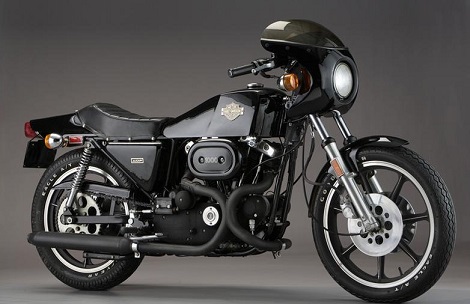
Although it was not popular in it's day, they have become sought-after collectables, and there have been who-knows-how-many privately built XLCR 'tribute" bikes (more on that below).
XLCR Frame
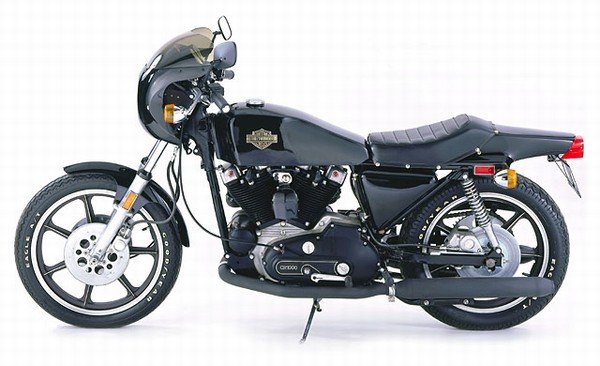
Designed for better handling and more lean angle, the new frame took some elements from the Harley XR750. The rear frame rails were extended, allowing rear shocks to be positioned more vertically. Wheelbase measured 58.5 inches.
XLCR Engine Specs
Sharing the same V-Twin engine as other 1977 Sportsters, a displacement of 997cc was achieved through a bore and stroke ratio of 3.2 x 3.8 inches. With a compression ratio of 9.0:1, 57 horsepower was achieved at 6,000 rpm.
The 'siamesed' exhaust was a departure from past Sportster models, and they made maintenance a little harder, but a solid five-horsepower was added. Cafe Racer models shared the same Keihin carburetor as other XL models.
All XLCR models left the factory as electric start only. Some have been retro-fitted to kick-start using 1979 XLCH parts.

Cast alloy wheels and dual-disc front brakes, optional on other Sportster models, were standard on the Cafe Racer.
The seven-spoke wheels, made by Morris, measured 19" up front and 18" at the rear. Factory tires were Goodyear raised white letters. A rear disc brake was fitted, which would appear on all 1979 and later Sportsters.
XLCR models also received a solid-state voltage regulator, as would all 1978 and later XL models. Valve timing was slightly more radical than other Sportsters.

Color Choices: the XLCR was offered in black only with wrinkle-black engine paint.
Real or Fake Harley Cafe Racer?
Fortunately for classic bike collectors, the Motor Company used unique VIN codes for all XLCR models. Whereas all other post-1970 Sportster VIN's will start with a 3A, 4A, or 4E, an XLCR VIN will start with a 7F.
Up until this time, The XLCR was the fastest and quickest Sportster model produced. Top speed of the 480-pound bike was around 110 mph.
They certainly weren't the fastest Cafe Racers out there, and they definitely weren't the best handling. But they were Harley-Davidsons.
1978 Harley XLCR
The Motor Company continued production of the Cafe Racer for 1978, competing against much lighter and faster bikes such as the Kawasaki Z-1, Ducati 900SS, and BMW R90S. Solo seating probably didn't help sales, so a dual saddle seat and axle-mounted passenger pegs were offered.
At the Daytona, Florida debut, the XLCR proved to be very popular with riders, but production delays held the bike back from retail sales until 1977. There were 1,923 produced in 1977, 1,201 produced in 1978, and just nine produced in early 1979. Unlike the first two model years, the 1979 Cafe Racers were equipped with an EPA-regulated air cleaner box.
Many sat in the dealer showrooms for years after production, and were sometimes discounted down to cost.
Harley Cafe Racer Replica
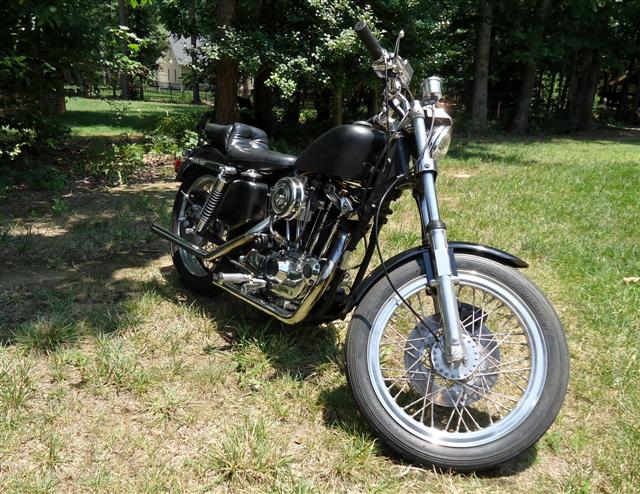
To build an XLCR replica, first choice is to start with a 1979 Ironhead. It's basically the same frame and engine. Most parts, including seat, exhaust, headlight mount and fairing are still available either used or reproduction. Paint the engine wrinkle-black and add an 18" rear wheel. The hardest part will be finding (or fabricating) rear foot controls.
Conclusion
While not fully appreciated in its day, the Harley Cafe Racer helped future Sportster models achieve better braking and cornering. Today, original XLCR models are prized collectors items.
There are too many over-chromed, high handlebar, feet-forward Harleys out there. The world needs more blacked-out, low handlebar, rearset-equipped Cafe-style Sportsters!
************
Related Articles:
Ironhead Sportster History
Ironhead Sportster Maintenance
Electric Start Ironheads
1977-1983 Harley Dual Caliper Rebuild
Replace Harley Fork Seals 35mm
Best Project Motorcycles