Adjust Valve Tappets Harley Flathead 45
Article by Mark Trotta
Required steps for adjusting Harley 45 tappets include unscrewing the four valve spring covers, slowly turning the engine and setting each tappet to it's lowest position, then checking and correcting tappet to valve stem clearances.
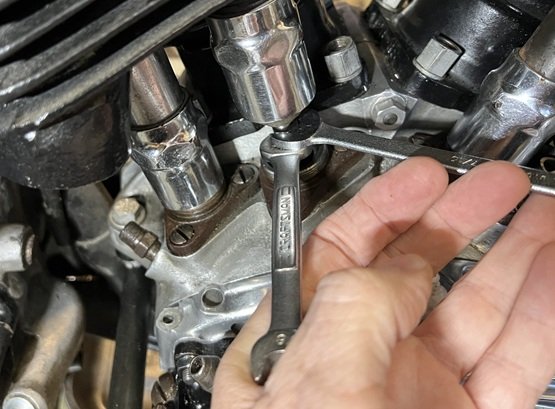
NOTE: Valve tappet adjustment is to be done when engine is cold.
Tools Needed
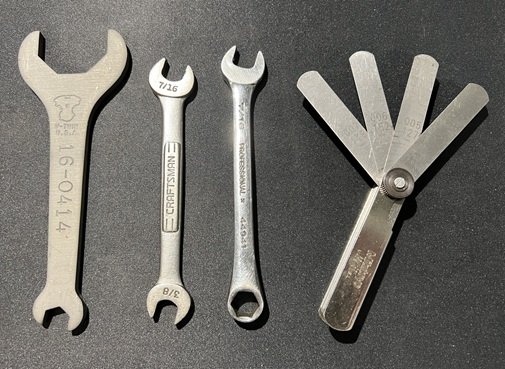
One special tool is required; a thin 1-7/8" wrench to loosen and tighten the valve spring covers.
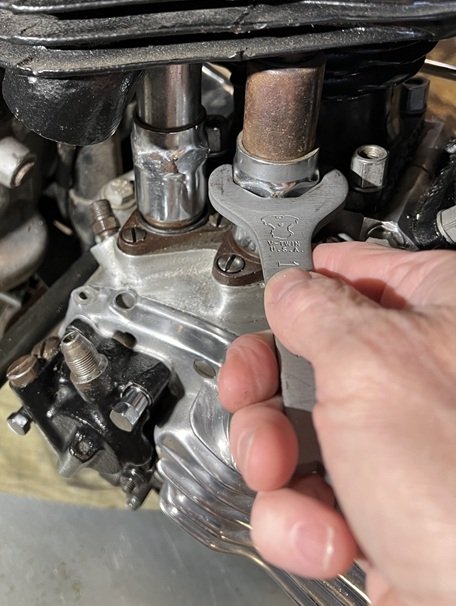
Notched Valve Cover Wrench by V-Twin Mfg replaces obsolete H-D tool 11806-31.
You'll also need two 7/16" open-end wrenches and a feeler gauge.
TIP: Before starting, inspect the gaskets underneath the valve spring covers. If any of the valve cover gaskets are broken, damaged, missing, or just plain old, this is the time to install new ones.
Getting Started
Removing the ignition timer and exhaust pipes isn't necessary, but I had already taken them off while removing the gear cover to replace a clogged breather valve.

Remove Spark Plugs?
A Harley 45 flathead is a very low compression motor, so you really don't have to remove the spark plugs to turn the engine over, but it does make it a little easier.
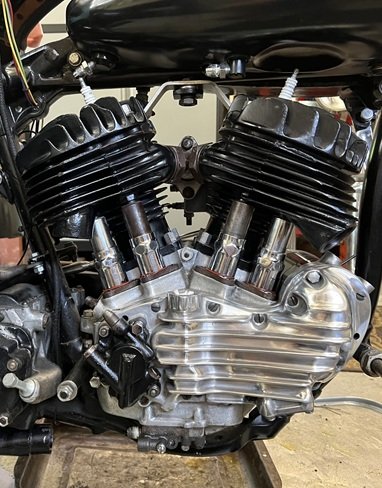
Turning Over Motor Without A Kick Pedal
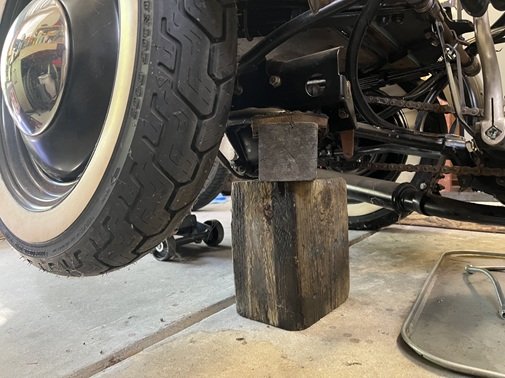
If your Servi-Car is an electric start with no kicker, you'll need to put it in third gear, get the rear wheels off the ground, and use the wheels to rotate the motor.
After unscrewing the valve spring covers off the threaded tappet blocks, prop them up with mechanics wire or wrap a twist-tie around them.
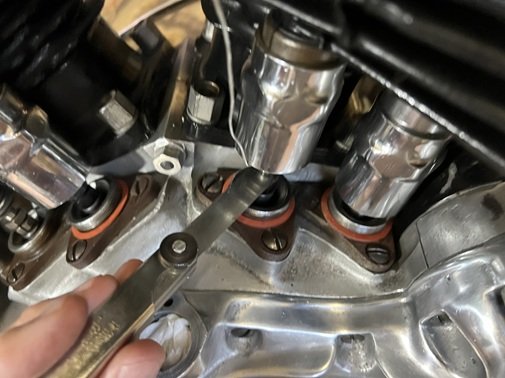
And sometimes, they stay in the up position all by themselves.
With the tappets now exposed, turn the engine over several cycles, and watch how they rise and fall. After a few rotations, you can anticipate when they'll go up and down.
Tappets are to be adjusted one at a time, at their lowest position (fully closed).
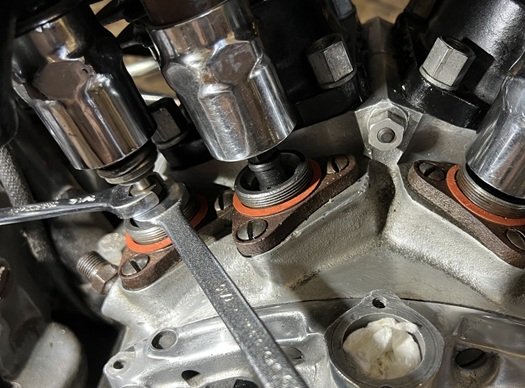
Intake (inlet) valves are those nearest to the carburetor, exhaust valves are furthest out. It doesn't matter what order you work in.
********
Adjust Intake Tappets
Turn the engine over until the inlet tappet is at it's lowest point.
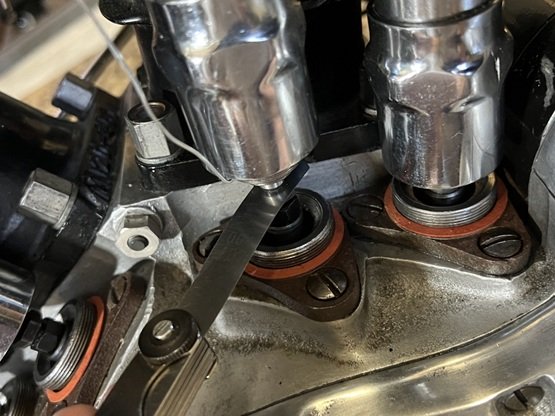
Select a feeler gauge blade and slip it into the gap. Recommended clearance for inlet tappets is .004" to .005".
Is there too much or too little play?
If adjustment is needed, loosen the bottom adjusting screw lock nut (7/16" wrench), then turn the adjusting screw above it (also 7/16" wrench).
When the proper clearance is achieved, the feeler gauge blade will be neither too tight nor too loose. Tighten the locknut while holding the adjusting screw and recheck the clearance.
Adjust Exhaust Tappets
Recommended clearance for exhaust tappets is .006" to .007".
NOTE: If an exhaust valve is adjusted too tight, it could burn a valve. So, better to leave them a little too loose.
Once clearance is corrected, tighten the locknut while holding the adjusting screw. Always recheck the clearance after tightening.
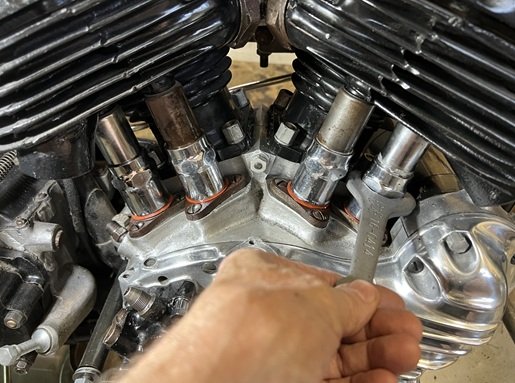
When done, push the valve spring covers back down and thread them on.
Lower Valve Cover Won't Thread Onto Tappet Block
On my 1961 Servi-Car, the front exhaust valve spring cover would not thread back onto the tappet block. After several unsuccessful attempts, I sprayed a little WD-40 around the top of the cover, and the issue was resolved.
********
Tappet Adjuster Screw and Nut
The factory lock nuts purposely have a cut in them. They are commonly called 'split nuts', which help prevent the nuts from loosening.
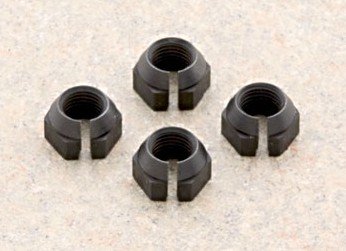
Pictured: Replacement tappet lock nuts for Harley 1915 to 1984.
Problems With The Lock Nut and Threaded Screw
Sometimes you'll find a lock nut that isn't turning freely, or binds in one spot, or got wrenched up too tight against the flared, unthreaded portion of the adjuster screw. All of these things will make proper adjustment difficult.
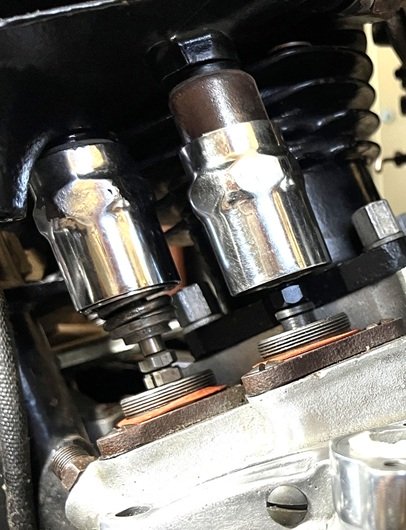
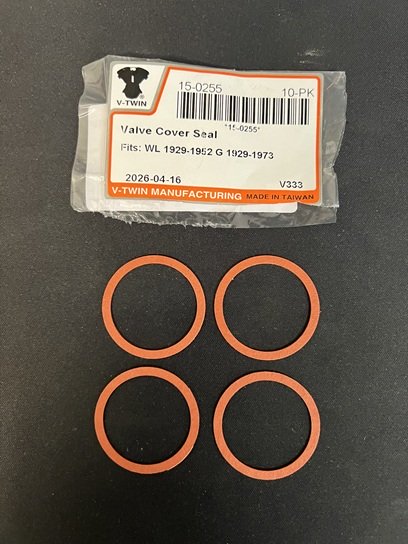
Fiber Washer Valve Cover Seals fit 1932 to 1973 Flathead 45's and replace OEM 18630-26 (sold as a 10-pack).
********
How Often Should Tappets Be Adjusted?
The service manual for 1940-1958 Servi-Cars and W Models recommends checking/adjusting valve tappets every 1,500 to 2,000 miles. It will also be required after replacing gaskets, servicing the valves and springs, or doing a full engine rebuild.
********
Related Articles: